
The Bandwidth Effect
Humans will own the atoms, AI will own the bits

I recently spoke at a meetup on the future or work. The undertone and focus was on how AI is going to take everyone job.
My position was simple. We have hit an inflection point. The inflection point is due to a change in 2 underlying fundamentals:
Humans are the exclusive form of all reasoning
Specialised knowledge was expensive to accumulate both in terms of time and money
These fundamentals prop up the digital economy. Digital content (media, computer code, etc) are created by humans interfacing with computers. This content is created by translating an individuals reasoning, knowledge and skill into a form that a computer can understand. Computers then distribute this content all over the world. The value has always been is in the individual manifesting their value and communicating it to the computer.
The people who could do this well are sought after to create this value. Because computers only understood specialised representations, being able to communicate via code, digital tools, etc has always been a specialised skill. This communication mechanism has been bandwidth constrained.
But that bandwidth has been massively increased. As before, bandwidth increases have led to large leaps forward in the forms of innovation cycles.
Bandwidth limitations - Atoms vs. Bits
I focused on 3 ways that humans create value - knowledge, labour and creativity. They combine to create value in different ways across 2 arenas - the real world and the digital world. In the real world they combine to manipulate atoms. In the digital world, bits.
Each world has a natural bandwidth limitation. In the real world the limitation is in how many atoms you can manipulate at a time. In the digital it’s how many bits.
Historically speaking, innovation cycles have come from these bandwidth limitations being removed via innovation in 3 areas - energy, materials and distribution
Breaking the limits - human innovation
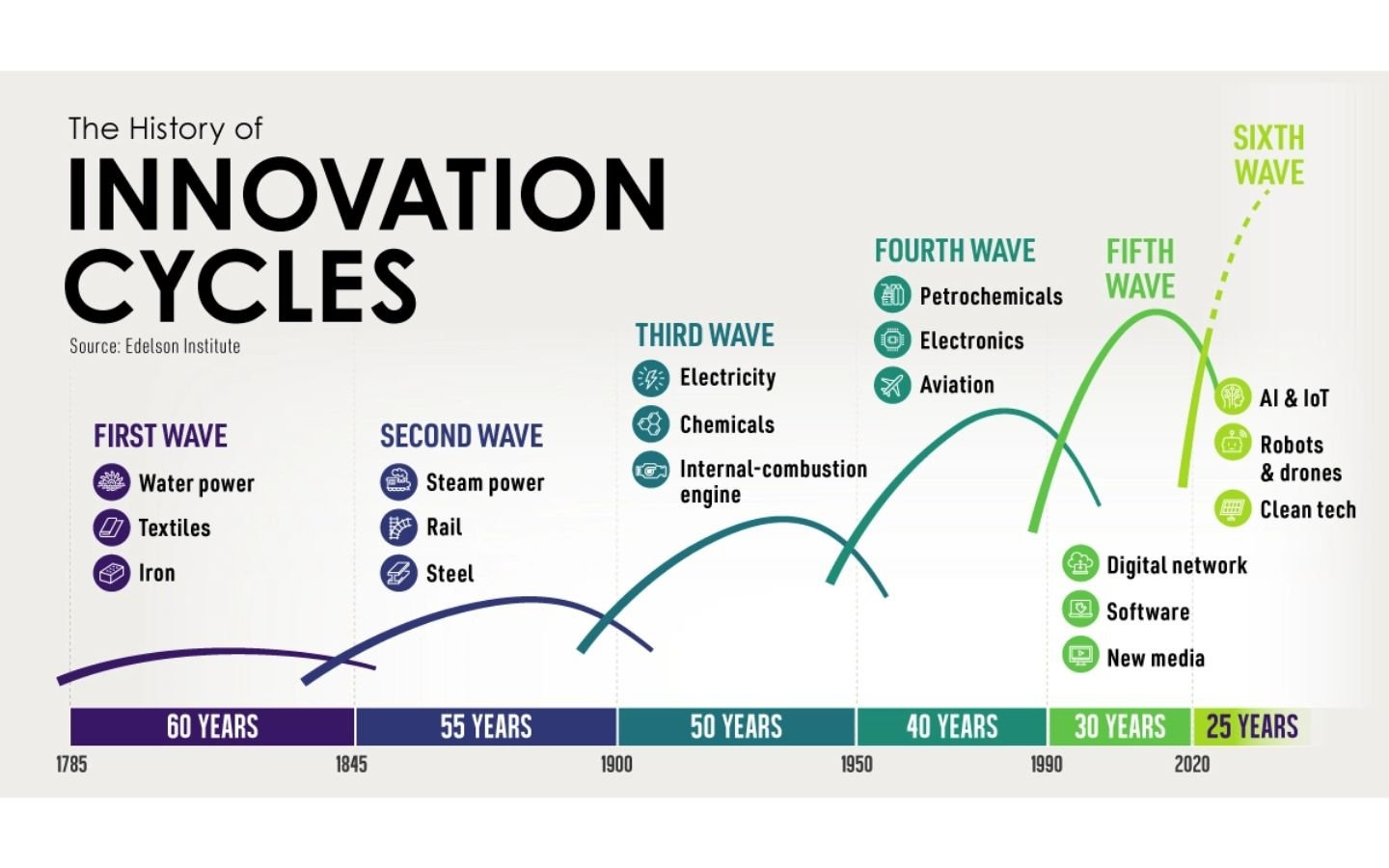
Economist Joseph Schumpeter coined the term creative destruction. This is the idea that innovation deconstructs established structures leading to new and more efficient systems. This is visualised above in 6 major cycles of innovation from 1785 to the present day.
In these cycles you’ll notice 3 things:
A new, more dense source of power is discovered (water → steam → electricity → petrochemical)
The raw materials available become more sophisticated (textiles → steel → chemicals → electronics)
Distribution spreads further (sea → rail → internal-combustion engine → aviation → digital networks)
On top of this the cycles get shorter as the bandwidth increases. Power is more dense, raw materials more sophisticated, distribution more digital.
Each new cycle is a mark of significant innovation made possible by significant bandwidth increases. Their culmination marked an inflection point.
Inflection points
A time in a business’s life when its fundamentals are about to change, potentially leading to either great opportunity or significant decline, requiring a fundamental shift in strategy
- Andy Grove, former Intel CEO
My current opinion is that we are at an inflection point in the digital world that will lead to a new innovation cycle. We are not past the inflection point in my view but we are in and around it, moving from an old paradigm to a new one.
This opinion is based on a the changing of the raw materials of digital world and the inverting of digital distribution as a result.
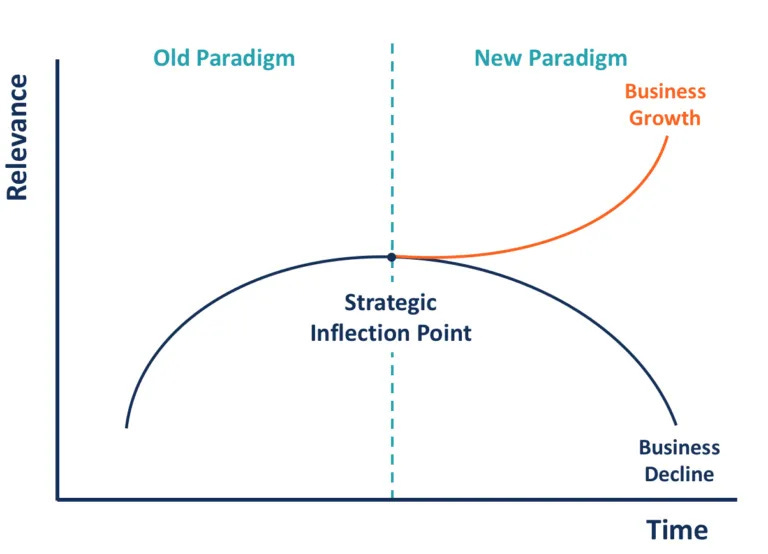
The change in raw materials comes from LLMs. They enable what I believe to be the second last interface between humans and computers - natural language. This interface has massively increased the bandwidth available making words the latest abstraction. Specialised knowledge is no longer needed to communicate ideas, thoughts, desires or intentions.
The bandwidth limitation is now a combination of how fast a conversation can occur and how much the LLM can understand in context.
Both are increasing month on month and challenging the 2 underlying fundamentals mentioned at the outset - human as the exclusive form of reasoning and the cost of knowledge being expensive.
The Rise of Artificial Reasoning
Artificial reasoning is accelerating at a pace where it challenges humans for specialist knowledge and expertise.
Reasoning is typically (but not exclusively) measured across the following dimensions:
Logical consistency
Factual grounding
Multi-step reasoning
Generalisation
Abstraction
and more.
Below is a table of how modern LLMs are fairing at reasoning tests.
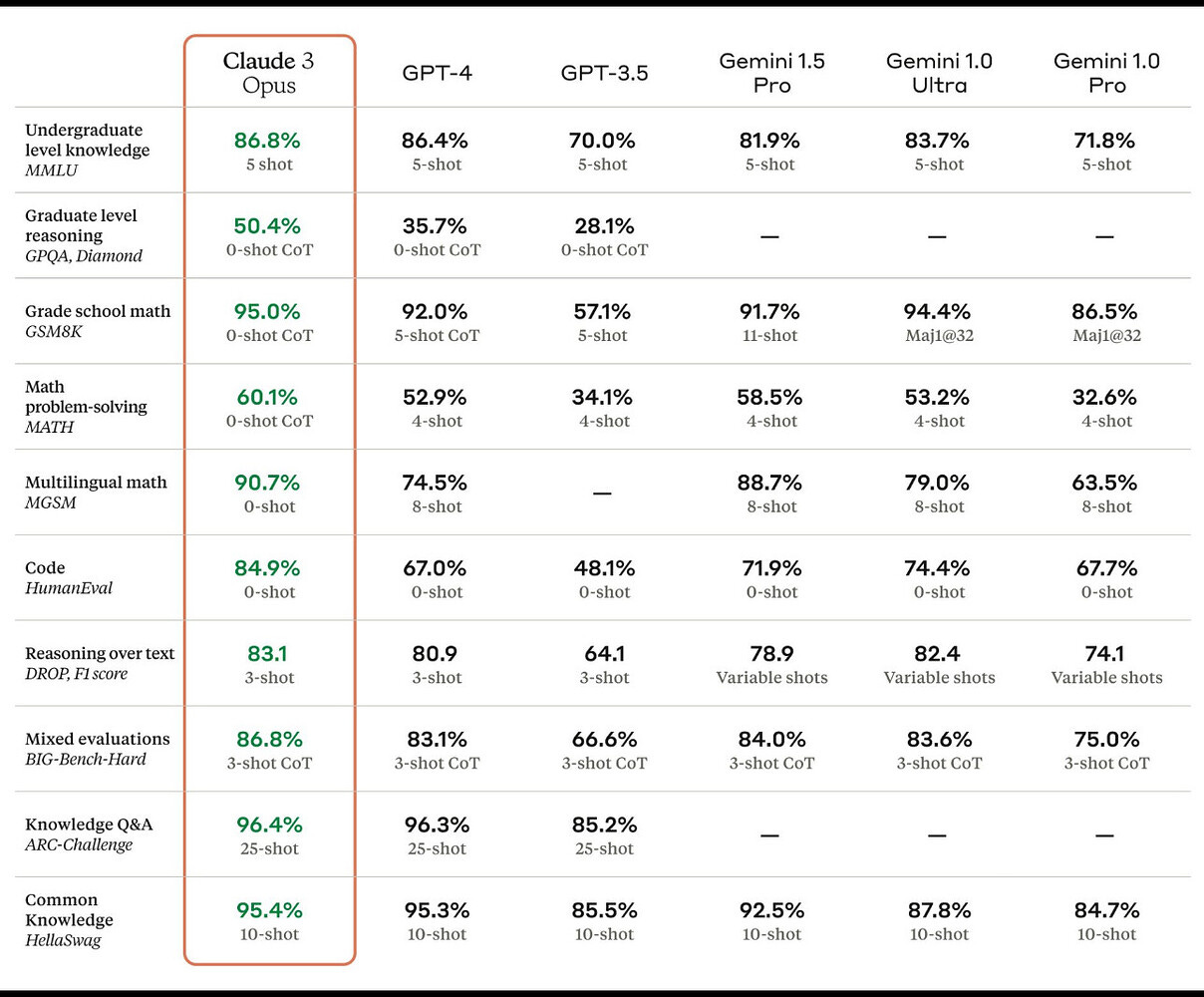
What is clearly visible is that each new version of an LLMs is improving significantly. Assuming these continue (and there is no reason not to) then LLMs will eventually surpass human reasoning.
But reasoning is just 1 part of the picture. The cost of access to this reasoning is trending towards zero.
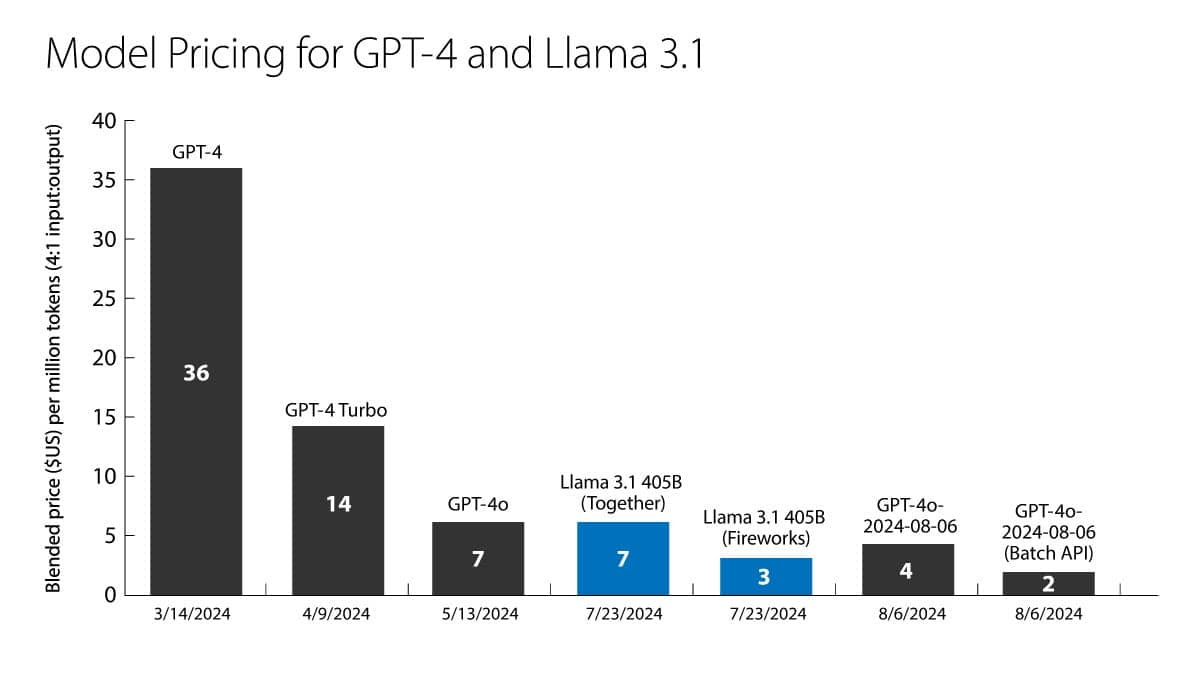
A clear industry trend over the past 12 months is that the cost per million tokens is decreasing rapidly. If this continues, artificial reasoning will be unmatched in affordability and breadth.
Bandwidth changed the fundamentals
These are the 2 fundamentals I outlined at the start. Humans no longer have exclusivity over reasoning. The time and cost to accumulate specialist knowledge is now cheaper to get from an LLM than a human.
LLMs are playing both sides. Their ability to ingest and generate natural language responses across different modalities has massively increased the bandwidth. It’s leading to the increase in their knowledge and their ability to reason. And it’s occurring at a pace and price that humans will eventually be unable to rival.
These shifting fundamentals are pushing those that work in the digital world towards an inflection point. That inflection point is going to form part of a new innovation cycle. That cycle will question the value of humans creating digital content by hand.
The timelines of this inflection point passing are unknown. I believe the innovation cycle has begun. Assuming a more dense form of energy source is discovered, it’ll be the fastest one yet.
I study Schumpeter at university and it was a good idea to base your article on a point of reference for technology and economics.